Designing Cash Flows: Turning Dirt into Details
How TOCCI is providing developers with strategic acquisition support services
The line between a groundbreaking project and a money pit often hinges on the decisions made before the first shovel hits the ground. We’ve combined the art of conceptual design, the science of cost modeling, and the agility of proformas to give developers the edge they need to transform vision into value.
Strategic Support from Day One: How we dig deep
The journey begins when our developer partners first set their sights on a site or start considering a new acquisition. At this pivotal moment, our process kicks into gear with a thorough site analysis and a skirmish with zoning codes. When you’re in the thick of planning a development project, the ability to pivot quickly between design, cost, and financial analysis is critical. At TOCCI, we’ve honed a process that integrates these three pillars from the outset, allowing for rapid iteration and smarter decision-making. We call it “Designing Cash Flows” and we don’t just gather data or crunch numbers; we bring these elements together in real-time, providing developers with a streamlined approach that maximizes value while mitigating risk.
Gathering Data That Matters:
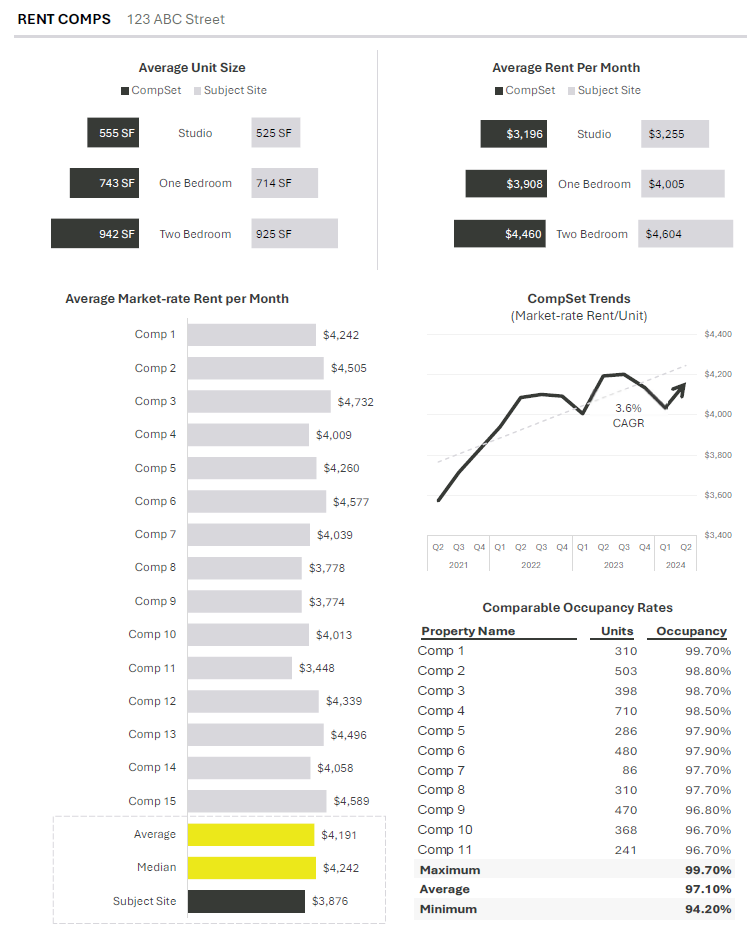
Our process starts with harvesting site-specific information from multiple sources—city/town GIS maps, assessor databases, zoning ordinances, and market intelligence platforms. We analyze rental and operating expense comps and conjugate that data with other proforma assumptions to guide initial design decisions. This goes beyond what you typically expect from an architect’s early-stage input. We understand that developers already have their methods for gathering market data and stress testing financial models. Our role is to complement that process—a second set of eyes, if you will. By sharing our research, financial models, and verified data points, we help you validate your assumptions. Think of it as a peer review for your project, ensuring that your numbers hold up before major decisions are made.
Design, Cost, and Financial Models: A Three-Way Balance
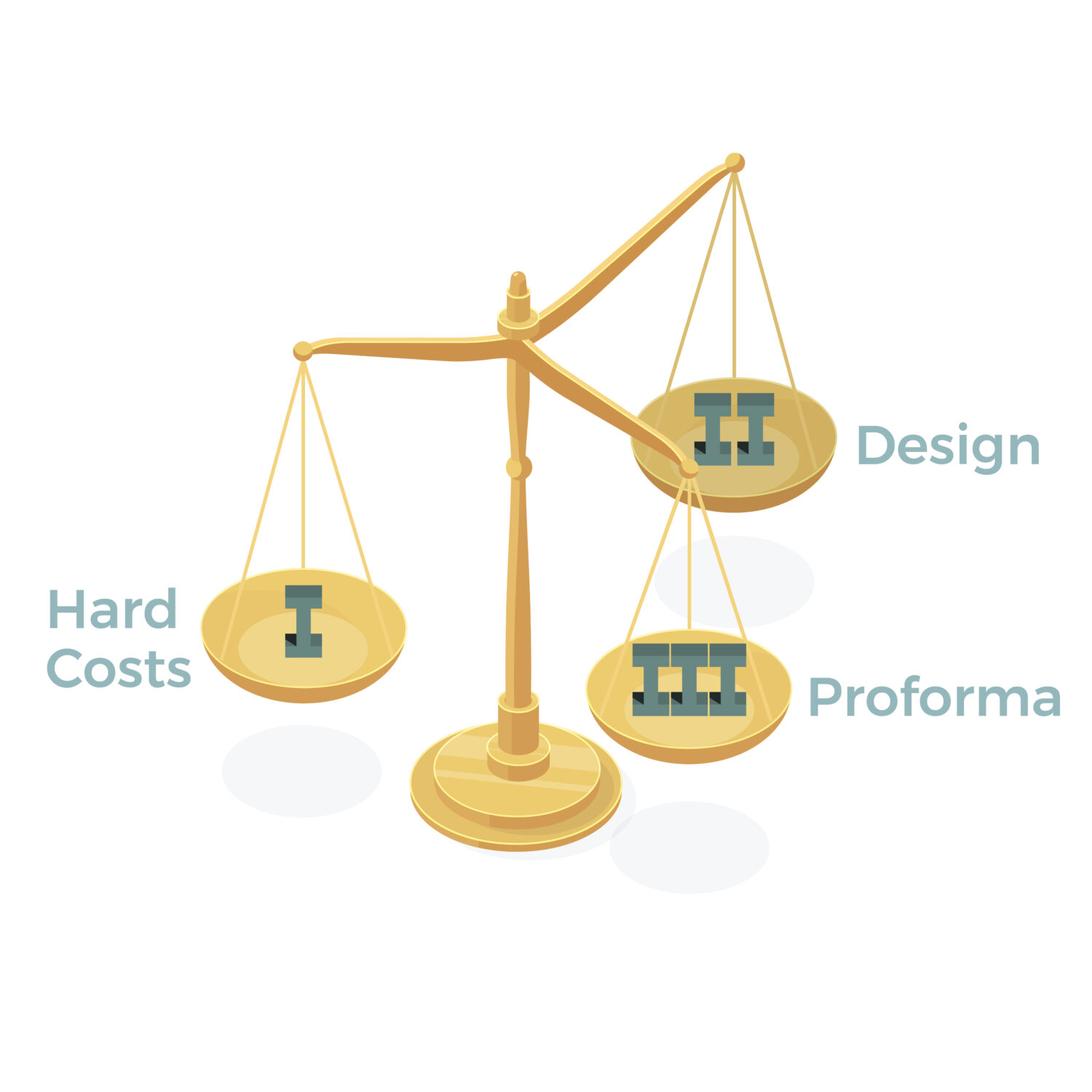
Once the data is in place, we move into balancing the three pillars: (1) design, (2) cost, and (3) proforma. Our ability to iterate across these areas swiftly gives us an edge in optimizing outcomes.
Click the triangles below to read more on our multi-disciplinary approach.
Pillar 1: Hard Costs (Paid for with Soft Dollars)
As a construction management firm, we maintain extensive construction cost databases and foster strong relationships with subcontractors, enabling us to generate an avalanche of value engineering ideas (ask us about 1515 Comm Ave) and obtain “street” pricing swiftly and effectively.
This information feeds directly into our parametric cost models, allowing us to shape construction estimates swiftly around shifting design variables like floor plans, density, and unit mix. Iterating on construction costs can often lead to redesigns, which drive up soft costs. By integrating real-time cost feedback and refining budgets as designs evolve, we minimize costly redesign cycles.
Pillar 2: Design (Dollars and Sense)
Architectural design, especially at the urban or site level, is inherently labor-intensive. We enhance this process by layering investment target returns onto design decisions.
Every iteration of unit mix, layout, or buildable area is analyzed through a financial lens, providing instant feedback that guides smarter design choices. This continuous feedback loop allows for more informed decision-making and ensures that design changes align with financial objectives, or desired yield targets.
Pillar 3: Proforma (Made to Measure)
We model proformas at two levels. The first is a quick “smell test” to gauge yield on cost using un-trended assumptions, providing an initial sense of direction.
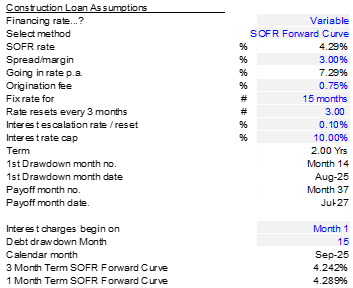
Once the design, cost, and market rent parameters are clearer, we move to a more advanced level of financial modeling at the project and partnership level. At this stage, we’re not just looking at yields, we’re torturing scores of assumptions to assess broader investment metrics, capital budgeting cash flows, and divine borrowing costs via interest rate forward curves in a bid to align with market expectations.
We also tinker with more advanced levers that dovetail into deal structuring, such as modeling distribution waterfalls based on various return thresholds and aligning capital partner contributions with different capital stack configurations.

An Optimized Approach: All in One Go
Traditionally, planning at the conceptual level involves handing off design to an architect, waiting a week for massing concepts, passing that along to CMs/GCs and soliciting cost estimates, which can take another few days. After that, it’s time to run the financials and hope everything aligns.
Our approach is different. We don’t work in silos. By integrating design, cost estimation, and financial modeling from the beginning, we can explore and refine over 20 different scenarios in the time it would typically take to receive one initial design package. The result? A process that’s faster, more responsive, and filled with value engineering opportunities that help you meet your project’s financial objectives without compromising on quality.
A Multidisciplinary Team: Diverse Experience Integrated
Whether you’re in the early conceptual stages or refining a near-final plan, our goal is to provide you with the tools, insights, and flexibility to make data-informed decisions at every turn. What makes our process truly unique is the diversity driving it. Our team is a powerhouse from various walks of the professional world—architecture, software engineering, finance, cost engineering and project management—each bringing their own set of skills to the table. This blend of disciplines lets us look at projects from every angle of the deal. By mixing these varied perspectives, we don’t just think outside the box—we redesign it, to unbox solutions.